Flowers in the Attic is, of course, told from a first person perspective, which makes things like the prologue and the sex with one’s sibling so poignant. No narrative distance here, no siree. There are limitations to this perspective though, and they revolve around the fact that young Cathy is a Debbie Downer.
“Oh, poor us! Our father died and I had to leave all my stuff behind and be locked in an attic with a sadistic grandmother who lashes out in the name of Jesus and all of the evil that family sex represents. Boo hoo…”
Well Cathy, your readers are trapped in the attic with you too and it wouldn’t hurt to stop moping for a little bit and look at the positives of the situation. On that note, I am introducing a new occasional column, “The Glass is Half Full,” in which we will explore reasons why it might not be so bad to live in an attic, or whatever else the dear girl is prattling on about.
Today, dear readers, we’re looking at Cathy’s relationship with time. She says, “What did you do with time when you had it in superabundance? Where did you put your eyes when you had already seen everything? What direction should your thoughts take, when daydreams could lead you into so much trouble?” and proceeds to mope and dope about how boring their shitty lives are.
Time is a wonderful thing! I haven’t had any for days. So Cathy’s cup may runneth over a little bit, but I bet she has plenty of time to keep her nails clipped and never finds that they’ve gotten embarrassingly long or snags her tights on them. They also get to go to bed at 7 o’clock EVERY NIGHT and have a nap too, which has to do wonders for the dark circles such as those that plague my own Caucasian, but not blue, eyes. “Taking many baths was another way to use up excess time, and shampooing made it last longer—oh, we were the cleanest children alive.” I love to bathe! They’re clean, well rested, and throughout the day they get to nosh on “little boxes of cheese crackers.” As a youth and an adult, I love food that comes individual portions. In fact, I love anything miniature, so what a pleasure it would be to have twins that “were more like three-year-olds than children of five.” Teeny tiny creepy children! Just for them! And throughout the book, Cathy makes references to the amount of time they spend lolling under sun beams in the nude with only a filthy mattress between their tender pink flesh and the filthy attic floor. While that’s not exactly my scene, I am sure that there are plenty of nudists and others that would revel in that opportunity.
This list is by no means conclusive, but I hope that it does demonstrate that being locked in an attic for the duration of one’s youth isn’t necessarily the worst fate that can befall humanity.
In a wee attempt at optimism, Cathy says“Chris said it was a deadly crime to waste time. Time was valuable. No one ever had time enough, or lived long enough to learn enough. All about us the world was on the way to the fir, crying, ‘Hurry, hurry, hurry!’ And look at us: we had time to spare, hours to fill, a million books to read, time to let our imagination take wing,” but Chris is a gay tool, so I’m not inclined to listen to him.
Tuesday, September 23, 2008

Monday, September 15, 2008
A Lesson Learned, Chapter 2
Or: Always pay attention to the foreshadow.
An important lesson, to be sure, but often overlooked. Maybe you get a funny feeling about that dude staring at you in the dark alley. Maybe that roller coaster looks a little rickety, and is it just me, or is the kid in the control box drunk?
Ah yes, the paranoia of every day living. It's easy enough to shrug off-- Why shouldn't he be leaning against a wall in an alley? Of course he's looking at me, I'm the only other person here!
And, Would they really keep running the roller coaster if it was about to fall apart? I mean COME ON! And how would a drunk kid ever get a job controlling a roller coaster? Get a grip!
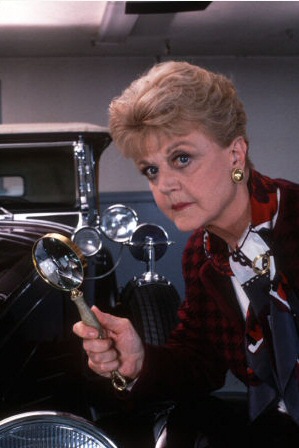
Sometimes these reality checks are necessary. You can't spend your life huddled in front of "Murder She Wrote" in your footy pajamas anticipating the next mysterious murder from the safety of your own pathetic papasan chair. Get out there, walk down that alley, get on that roller coaster, give the drunk kid a chance.
But.
But.
But.
At other times, and other more serious encounters with the foreshadow, I suggest you get your head out of your you-know-what and watch out!
Chapter 2, The Road to Riches
Life Lesson #1: Heed the foreshadow
So maybe nothing all that weird happened in chapter 1. I'm willing to give these kids the ginormous benefit of the doubt and say they did not have ample warning of their impending doom until chapter 2. In chapter 1 their dad died, they found out their mom is incompetent, and that they're about to be broke. They were rightly distraught, and thus not up to sleuthing; I understand. I try to put myself in their shoes. This is how I would react in their situation. (See page 40 in my copy of the book to follow along.)
Mum: Gather some clothes and toys for your siblings. Fit them all in one suitcase. We're going to visit grandma.
Me: Ok Ma... I wish I had a dad.
*hours later, middle of the night, on a deserted road surrounded by trees*
Mum: It's not much farther. Keep going.
Me: Ma, why do we have to walk all the way to grandma's in the middle of the night? My young siblings are tired and so am I.
Mum: Well I can't very well show up at my parent's house in the middle of the day with 4 children, now can I?!
Me: I guess that makes sense.
*tired out from being 5 years old and hiking 15 miles, siblings fall asleep*
Mum: Wake them up! Stand them on their feet and force them to walk, whether they want to or not!
Me: But, Ma...
*Mum mutters something under her breath, something only I can hear* [Foreshadow alert!]
Mum: Lord knows they better walk outside while they can...
Me: AHHHHHHHHH!! RUN SIBLINGS, RUN!!!!
That, at least, is what I would do. Or, that's what I will do thanks to this book. Still, that's not what our 4 young heroes did. Instead they kept going and soon found themselves at grandma's house.
Foreshadow Lesson #2: How to know when your grandma is about to lock you in the attic
If she has, as you say, "a bosom like twin hills of concrete," and the first thing she says about you (in your presence) is, "But are you sure they are intelligent? Do they have some invisible afflictions not apparent to the eyes?"
And if the first thing she says to you is, "You all keep quiet! If your grandfather learns you are up here, he will throw all of you out without one red penny-- after he has severely punished you for being alive!"
This is a no-brainer. If you're going to be punished just for being alive--listen to your paranoia, run for it.
And finally, Foreshadow Lesson #3: So are you a product of incest or not?
(If you find yourself wondering, then the answer is likely "yes.")
But here's one telltale sign. If your grandma tells your mom that you and your bro can't share a bed, and your mom defends you saying "They're only children! They're innocent." And then your grandma says to your mom, "Innocent? That is exactly what your father and I always presumed about you and your half-uncle!"
Ouch.
Chapter 2 didn't exactly dole the foreshadowing out subtly. Those kids just lost my benefit of the doubt. They're idiots. Please learn from their poor example. Just stay inside with Jessica Fletcher.
Saturday, August 30, 2008
A Lesson Learned, Chapter 1
This is the sort of book that you begin and become immediately aware that something inside you is about to be irreversibly changed. But by the time you realize that, it's too late, so you might as well keep reading. Luckily the change you will find in yourself is one of heightened wisdom, empathy, and optimism. I've learned many many life-lessons from this book. I believe everyone can benefit from these, so I will share one (maybe two if the situation calls) from each chapter.
Chapter 1, Goodbye Daddy
Life lesson #1:
Our heroine's father is killed tragically in a car accident in the early pages of the book, and by page 17 young Cathy is already sick of good-intentioned funeral-goers (maybe like yourself?) saying things like, "Our days are numbered...that's the way it is, from the day we're born our days are numbered." Ain't it the truth, you might think but sometimes a simple tuna casserole is more than enough. In fatherless Cathy's own exasperated words, "Yet I hated it every time someone asked how he died, and what a pity when someone so young should die, when so many who were useless and unfit, lived on and on, and were a burden to society."
I've only been to two funerals but I've already made the mistake of saying both of those things. These pages helped me to remember that when you're consoling a friend, you have to be aware that everyone else is probably telling them the same thing, so you have to be more creative. How about a shoulder to cry on instead? Maybe a stuffed bear for hugging? A copy of Beaches on VHS? Sometimes words just aren't enough. Now I will be a more sensitive friend and funeral-goer. Thank you, book.
Chapter 1, Goodbye Daddy
Life lesson #1:
Our heroine's father is killed tragically in a car accident in the early pages of the book, and by page 17 young Cathy is already sick of good-intentioned funeral-goers (maybe like yourself?) saying things like, "Our days are numbered...that's the way it is, from the day we're born our days are numbered." Ain't it the truth, you might think but sometimes a simple tuna casserole is more than enough. In fatherless Cathy's own exasperated words, "Yet I hated it every time someone asked how he died, and what a pity when someone so young should die, when so many who were useless and unfit, lived on and on, and were a burden to society."
I've only been to two funerals but I've already made the mistake of saying both of those things. These pages helped me to remember that when you're consoling a friend, you have to be aware that everyone else is probably telling them the same thing, so you have to be more creative. How about a shoulder to cry on instead? Maybe a stuffed bear for hugging? A copy of Beaches on VHS? Sometimes words just aren't enough. Now I will be a more sensitive friend and funeral-goer. Thank you, book.
Friday, August 29, 2008
Buying the Book: An Exploration of Neurosis and Genre
Within a relatively short period of time, I was called upon to make two purchases that I didn’t feel entirely comfortable asking for help on. The first was a hot dog toaster. I wandered all of the Houseware sections within the Cambridgeside Galleria, scanned the shelves, and tried to make sure my giant backpack didn’t knock anything over. The second purchase, the one relevant to this blog, was Flowers in the Attic. I strode confidently into the Fiction/Literature section at Borders, after all, FITA is a classic and it ought to be with the “real” books. No dice. Fiction contained nary a trace of Ms. Andrew’s pre or posthumous oeuvre. Clearly it had been relegated to Genre.
Last spring, I went to MIT to watch Neil Gaiman speak. Among other things, he provided his definition of genre, calling it a “loose contract between author and audience.” He went on to say, “If the plot is a machine that allows you to get from set piece to set piece, and if the reader felt lost without the set pieces, it is genre.” I strained my summer vacation brain to what I remembered about FITA so as to identify Neil’s “set pieces” and ultimately use the power of my mind to determine the Borders classification. The machinery quickly spat out “siblings having sex… blonde people,” before it groaned a bit, such was the effort of retrieving memories from sixteen years ago. “An attic?” I looked around furtively, I didn’t want to be recognized, and headed to the Romance section. (Located quite boldly in the center of the store.) I peeked longingly over the shelf to the Sci-Fi/Fantasy section where I would have felt much more at home and allowed myself a moment to listen in on the geeky employee talking about Star Trek novels. I sighed longingly but was on a mission. Alas, it was for naught. Our fair saga was not in fact considered a romance novel, despite what my remembered “set pieces” indicated.
I briefly thought about asking the geeky employee for helped, but pride and social phobia dictated otherwise. I decided to hit the Customer Kiosk instead. I’d hesitated to use these because despite the fact that they are clearly labeled as “For Customer Use,” I feel a little bit like a bookstore hacker and don’t want to get in trouble. I punched Flowers in the Attic into the title field. If the computer could have talked it would have said, “Ugh, we don’t have any of those in the store, but if we did, it would be in the Horror section. Duh. Would you like to try some of these more recent titles ‘written’ by VC Andrews. I’m sure they probably have a little bit of incest too. You didn’t look in Romance did you? Also, if you want to wait 6,000 years, I can order one for you.” Chatty little thing, that imaginary computer.
I could riff for pages about how I identified the remembered “set pieces” as Romance and completely overlooked the Horror elements of the plot: child abuse, murder, torture. How I reduced what generous sources call as Gothic novel to golden haired children finding lust in a sunny attic. I could go into a complicated cross textual comparison of literal monsters in horror novels versus figurative ones, and ultimately determine that all monsters are literal, even if they take figurative form. (Proving this thesis would require a lot of posturing on my part.) Instead, I’ll tell you about how I went home and ordered it from Amazon, along with a copy of the Gaiman/Pratchett classic, Good Omens and the soundtrack to [Title of Show]. The latter, ironically, is a meta-musical commenting on the genre of the musical. My mind is blown, but I digress.
Returning to FITA, I will close this entry with one more quote from Gaiman’s genre talk: “Life does not obey genre rules.” Speaking for all of us with siblings, thank god

Last spring, I went to MIT to watch Neil Gaiman speak. Among other things, he provided his definition of genre, calling it a “loose contract between author and audience.” He went on to say, “If the plot is a machine that allows you to get from set piece to set piece, and if the reader felt lost without the set pieces, it is genre.” I strained my summer vacation brain to what I remembered about FITA so as to identify Neil’s “set pieces” and ultimately use the power of my mind to determine the Borders classification. The machinery quickly spat out “siblings having sex… blonde people,” before it groaned a bit, such was the effort of retrieving memories from sixteen years ago. “An attic?” I looked around furtively, I didn’t want to be recognized, and headed to the Romance section. (Located quite boldly in the center of the store.) I peeked longingly over the shelf to the Sci-Fi/Fantasy section where I would have felt much more at home and allowed myself a moment to listen in on the geeky employee talking about Star Trek novels. I sighed longingly but was on a mission. Alas, it was for naught. Our fair saga was not in fact considered a romance novel, despite what my remembered “set pieces” indicated.
I briefly thought about asking the geeky employee for helped, but pride and social phobia dictated otherwise. I decided to hit the Customer Kiosk instead. I’d hesitated to use these because despite the fact that they are clearly labeled as “For Customer Use,” I feel a little bit like a bookstore hacker and don’t want to get in trouble. I punched Flowers in the Attic into the title field. If the computer could have talked it would have said, “Ugh, we don’t have any of those in the store, but if we did, it would be in the Horror section. Duh. Would you like to try some of these more recent titles ‘written’ by VC Andrews. I’m sure they probably have a little bit of incest too. You didn’t look in Romance did you? Also, if you want to wait 6,000 years, I can order one for you.” Chatty little thing, that imaginary computer.
I could riff for pages about how I identified the remembered “set pieces” as Romance and completely overlooked the Horror elements of the plot: child abuse, murder, torture. How I reduced what generous sources call as Gothic novel to golden haired children finding lust in a sunny attic. I could go into a complicated cross textual comparison of literal monsters in horror novels versus figurative ones, and ultimately determine that all monsters are literal, even if they take figurative form. (Proving this thesis would require a lot of posturing on my part.) Instead, I’ll tell you about how I went home and ordered it from Amazon, along with a copy of the Gaiman/Pratchett classic, Good Omens and the soundtrack to [Title of Show]. The latter, ironically, is a meta-musical commenting on the genre of the musical. My mind is blown, but I digress.
Returning to FITA, I will close this entry with one more quote from Gaiman’s genre talk: “Life does not obey genre rules.” Speaking for all of us with siblings, thank god
Wednesday, August 27, 2008
Quest for Truth Part 2
I've got much to say about how I came to pick up (and analyze, and blog about) this book, but first let me weigh in on my counterpart's-- Grandmother's-- quest for the truth behind this knife-wielding prologue and book. I turn to the dedication.
This book is dedicated to my mother.
OR is it something a tad more passive aggressive? It's all tomatoes, I suppose, and after all fiction will be "fiction" as "Cathy" points out. But let's dare to speculate. A bit of research (ie. the first hit on a google search) will thicken the plot. According to one maybe-reliable website, VC's first ever story, which she had to write in secret (it's unexplained as to why, but maybe a crazy moms had something to do with it), had to be destroyed because it was too autobiographical and she wanted to keep her life private. Jump ahead a few years and her first published story is elusively titled, "I Slept With My Uncle On My Wedding Night." I can't say for sure what it's about since I don't own the collected works. I have just now reluctantly typed this title into the interweb and a discussion board popped up with some fans desperate for a copy. It seems to have never been located. But give it time. The hunt is on.
Finally, Andrews herself described the first draft of Flowers in the Attic as containing "unspeakable things my mother didn't want me writing about." Fair enough. I guess people write about things their mothers don't want them writing about all the time. And also true, most mothers probably would prefer that their children did not show a great interest in incest. I'd venture so far as to guess that most mothers would rather that their daughters did not write novels that claim to be memoirs about their childhood abuse and incestuous romance, especially if said daughter then plans on dedicating said novel to said mother. Said daughter admits that she knew this, and so, even if said "fiction" is the made-up kind of fiction and not the "fiction" kind of fiction, this dedication--conclusively--ain't the nice kind.
Finally, Andrews herself described the first draft of Flowers in the Attic as containing "unspeakable things my mother didn't want me writing about." Fair enough. I guess people write about things their mothers don't want them writing about all the time. And also true, most mothers probably would prefer that their children did not show a great interest in incest. I'd venture so far as to guess that most mothers would rather that their daughters did not write novels that claim to be memoirs about their childhood abuse and incestuous romance, especially if said daughter then plans on dedicating said novel to said mother. Said daughter admits that she knew this, and so, even if said "fiction" is the made-up kind of fiction and not the "fiction" kind of fiction, this dedication--conclusively--ain't the nice kind.
Reading the Prologue: A Quest for Truth
So, like Charles Dickens, in this book of “fiction” I will hide myself away behind a false name, and live in fake places, and I will pray to God that those who should will hurt when they read what I have to say. Certainly God in his infinite mercy will see that some understanding publisher will put my words in a book, and help grind the knife that I hope to wield.
The prologue to our fair tome breaks the literary fourth wall, addresses the reader, and acknowledges the rather boorish nature of the prose to come. As my fingers eagerly turned the pages of my hot pink volume, I was left to wonder about the purpose of this pseudo realistic prologue; the fictional acknowledgment that the lovely Chris, Cathy, Cory, and Carrie had actually been locked in an attic by their evil grandmother and left to sexually awaken in each other’s arms. Was the hope that a prologue claiming realism would elevate the status of the familial bodice ripper to the great literature of orphans, underdogs, and scoundrels? Was it meant to legitimize the enterprise of writing and reading about four children of incest, two of whom are drawn to one another by the alluring thrall of puberty mixed with claustrophobia?
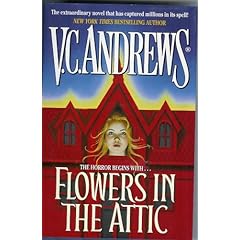
Armed with these questions, and a slightly dirty feeling left over from the passa ge that I read earlier today, I asked the internet. Into my Google search box I typed, “Flowers in the Attic True Story?” The Wikipedia article was practically useless, but it did provide useful links. The Fantastic Fiction link brought me to a photograph of V.C. Andrews. With great haste, I noted that she was blonde. A clue! The over exposed boy and girl touching noses on the cover of my book were blonde. And the novel itself acknowledged this particular Caucasian leaning saying, “…we were all blond, flaxen haired with fair complexions (except Daddy with his perpetual tan.” Check in the column of the prologue clearly indicating that Flowers in the Attic was based on a true story.
I then clinked on the link to The Complete VC Andrews, which provided, among other things, a Frequently Asked Question section. I quote, “Is Flowers in the Attic based on a true story?” The author of the FAQ section answered the question in rather explicit detail, citing Ms. Andrew’s acknowledgment that elements of her stories (undisclosed) were based on life, as well as her own dreams and fantasies. Slightly harshly they remind the reader that while only Ms. Andrew’s could truly answer this question, she is quite dead and has been since 1986. (Despite the fact that her next book is due out in September.) Further, the author of the FAQ indicates that just because you read something doesn’t mean it’s true. I nodded my head in somber agreement, and then I began to read possible theories put forth to explain the root of the true story rumors. Snidely putting aside my own reading of the prologue which clearly stated that it was a true story, I quote again: “The story itself is so realistic, why couldn't it happen for real?” and “There was a similar news story around the same time that the book came out, and it was assumed that the two were related.” Word. The true story rumors got told. (Yes, I am in the process of searching for the allusive "similar news story.")
I am a diligent Googler though, and clicked on one more website, Snopes.com, which is devoted to getting to the bottom of rumors and urban legends. On January 28, 2004, CJ inquired as to the validity of the true story rumors. I tried reading through the three pages of answers, but the conversation pretty much devolved to a general discussion of the incestuous nature of the book and how odd it is that it’s mostly read by adolescent girls. As that is the intended topic of this blog, I didn’t want to feel redundant, so I pretended I hadn’t read it.
The fact that the discussion immediately went where it did was telling though. Sure, we can speculate about whether or not VC Andrews spent her youth boinking her blonde brother in an attic and that the biographical information regarding a crippling accident and commercial artistry is all a bunch of hooey. But, the fact of the matter is, the cultural significance of Flowers in the Attic has nothing to do with truth or fiction. Rather it has to do with the reality of the naughty feeling that so many of us had as we laid on our couch at eleven, eyeing our parents and siblings suspiciously, while thinking, “They did that? With their sibling? I didn’t even know you could do that,” and then took a cold, cold shower.
The prologue to our fair tome breaks the literary fourth wall, addresses the reader, and acknowledges the rather boorish nature of the prose to come. As my fingers eagerly turned the pages of my hot pink volume, I was left to wonder about the purpose of this pseudo realistic prologue; the fictional acknowledgment that the lovely Chris, Cathy, Cory, and Carrie had actually been locked in an attic by their evil grandmother and left to sexually awaken in each other’s arms. Was the hope that a prologue claiming realism would elevate the status of the familial bodice ripper to the great literature of orphans, underdogs, and scoundrels? Was it meant to legitimize the enterprise of writing and reading about four children of incest, two of whom are drawn to one another by the alluring thrall of puberty mixed with claustrophobia?
Armed with these questions, and a slightly dirty feeling left over from the passa
ge that I read earlier today, I asked the internet. Into my Google search box I typed, “Flowers in the Attic True Story?” The Wikipedia article was practically useless, but it did provide useful links. The Fantastic Fiction link brought me to a photograph of V.C. Andrews. With great haste, I noted that she was blonde. A clue! The over exposed boy and girl touching noses on the cover of my book were blonde. And the novel itself acknowledged this particular Caucasian leaning saying, “…we were all blond, flaxen haired with fair complexions (except Daddy with his perpetual tan.” Check in the column of the prologue clearly indicating that Flowers in the Attic was based on a true story.
I then clinked on the link to The Complete VC Andrews, which provided, among other things, a Frequently Asked Question section. I quote, “Is Flowers in the Attic based on a true story?” The author of the FAQ section answered the question in rather explicit detail, citing Ms. Andrew’s acknowledgment that elements of her stories (undisclosed) were based on life, as well as her own dreams and fantasies. Slightly harshly they remind the reader that while only Ms. Andrew’s could truly answer this question, she is quite dead and has been since 1986. (Despite the fact that her next book is due out in September.) Further, the author of the FAQ indicates that just because you read something doesn’t mean it’s true. I nodded my head in somber agreement, and then I began to read possible theories put forth to explain the root of the true story rumors. Snidely putting aside my own reading of the prologue which clearly stated that it was a true story, I quote again: “The story itself is so realistic, why couldn't it happen for real?” and “There was a similar news story around the same time that the book came out, and it was assumed that the two were related.” Word. The true story rumors got told. (Yes, I am in the process of searching for the allusive "similar news story.")
I am a diligent Googler though, and clicked on one more website, Snopes.com, which is devoted to getting to the bottom of rumors and urban legends. On January 28, 2004, CJ inquired as to the validity of the true story rumors. I tried reading through the three pages of answers, but the conversation pretty much devolved to a general discussion of the incestuous nature of the book and how odd it is that it’s mostly read by adolescent girls. As that is the intended topic of this blog, I didn’t want to feel redundant, so I pretended I hadn’t read it.
The fact that the discussion immediately went where it did was telling though. Sure, we can speculate about whether or not VC Andrews spent her youth boinking her blonde brother in an attic and that the biographical information regarding a crippling accident and commercial artistry is all a bunch of hooey. But, the fact of the matter is, the cultural significance of Flowers in the Attic has nothing to do with truth or fiction. Rather it has to do with the reality of the naughty feeling that so many of us had as we laid on our couch at eleven, eyeing our parents and siblings suspiciously, while thinking, “They did that? With their sibling? I didn’t even know you could do that,” and then took a cold, cold shower.
Subscribe to:
Comments (Atom)